
A pig built the nest of her dreams
Here at BOTL Farm, we had so much we wanted to talk about this month that we politely argued about which topics would make it into this newsletter for days. Options ranged from good things (hot dogs are back in stock!) to sticky, sensitive issues (local farmers greenwashing the crap out of their products) to boring (we reworked our website again) [editor notes this is not at all boring for us, only other people]. Instead of any of that nonsense, we decided to talk about nesting pigs (but if you’re interested, ask us about those other topics and get ready for lots of words).
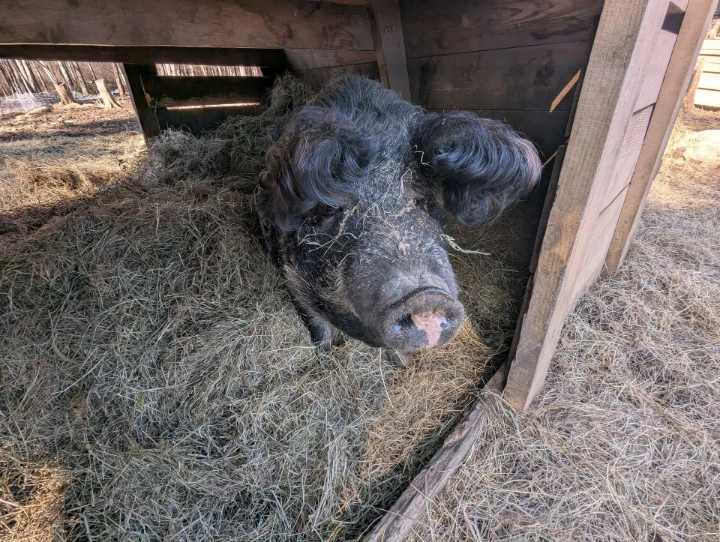
Pigs have a lot of personality. When sows (pig moms) are about to farrow (give birth), we provide them lots of space, lots of nesting material, and at least one portable shelter. Nest material is required by our animal welfare certification in pig standard 4.3.16, but we know from experience that sows have strong instincts to build nests. Our sows build nests of all sizes, shapes, and densities with widely varying nesting material. Our most dedicated nest builder, Rahm, will routinely take down inch-wide saplings, shred them a bit, and stuff them into her nest. Our biggest sow is also our sloppiest nest builder: she piles just enough grass or hay so that she can poke her head underneath.
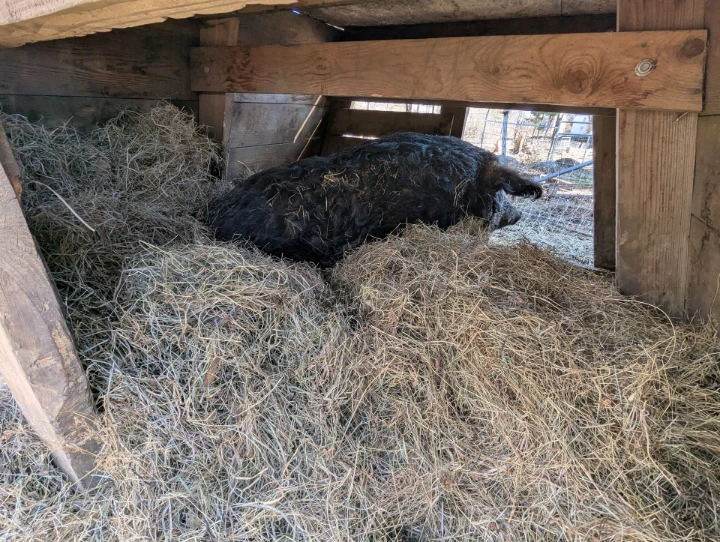
One of our newer sows is farrowing and we’re not yet sure of her exact nesting preferences, so when we went out to check on her the other day, we were a little horrified to see her work, which she was obviously quite proud of. She had taken an enormous amount of hay (at least three bales, so more than 100 lbs) and shoved it in as a base. Then she emptied her 15 gallon rubber bowl of water and dragged that in (at least, that’s what we think she did. We haven’t seen the bowl so far [editor notes that we have confirmed the bowl is part of the nest]). Not yet finished, she used her mouth to pull down some nearby fencing and pushed that into the depth of her nest.
We didn’t want to offend her, so we left all the hay and the water bowl, but we did carefully reclaim the fencing. We got her a fresh bowl of water and are looking forward to seeing her deposit a litter of healthy piglets into the nest of her dreams.
What’s a HACCP?
Although Nick usually goes to farming conferences and trainings, we had a notable exception this month when Danielle attended a two-day HACCP training for meat and poultry processors in sunny New Hampshire. HACCP stands for Hazards Analysis and Critical Control Points and is a fancy, technical food safety plan. We ended up writing a HACCP plan for ourselves because we make raw pork sausages in reduced oxygen packaging (technical name for ‘vacuum sealing’) at a cooperative commercial kitchen.
HACCP plans are typical for industrial food manufacturers and USDA inspected slaughterhouses, not for a small farm selling direct to consumer. However, we worked through the (surprisingly painful) process with some professional help (thanks, AgriForaging!) and we are now the first HACCP-approved farm that the local health department has ever dealt with (we’re pretty sure we were their first HACCP plan ever, not just from a farm).
Although we have the approved plan in place, there’s still a lot to learn and Danielle had a really nice time at the training. It was a purposefully small group so that everyone’s operation could be discussed, but Danielle saw some familiar faces – Meatworks (the large-animal slaughterhouse we use), as well as Short Creek (who makes our snack sticks, coming soon), and Maple Wind Farm (a farm and poultry slaughter facility that we’d totally use if they were closer). It was a nice reminder that the circle of livestock farmers and processors in New England is a relatively small, tight-knit community who are willing to work together and support each other. A rising tide raises all ships (farms?).
Bye bye, mud season
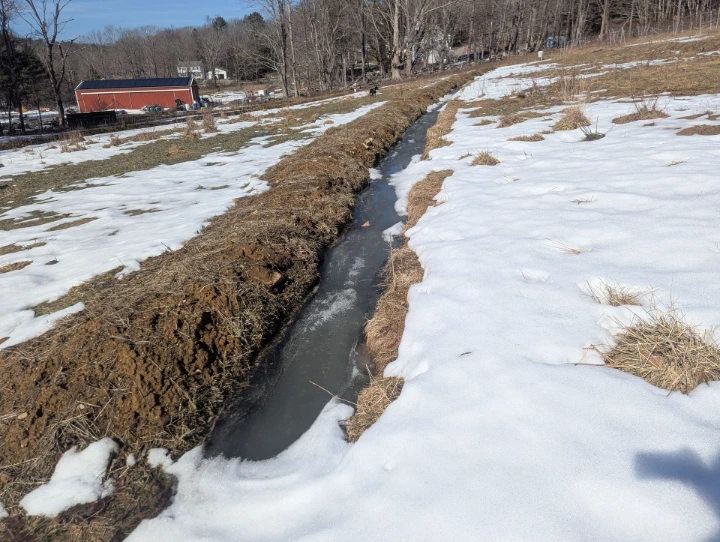
Our huge snowpack finally melted this month, thanks in part to getting lots of rain. Oops, looks like this is farmers talking about the weather again, but hold on. This thawing and warming season is what farmers call, not very affectionately, ‘mud season.’ Grass isn’t quite growing yet, there’s a lot of water around, and it gets really messy really fast.
As our biggest fans may recall, last fall we talked about how we had dug long ditches into our main fields, called ‘swales.’ They are dug on contour lines, meaning that each 100+ foot long swale is at the same elevation. We’re happy to see them catching and storing water until it can slowly seep into the ground, as opposed to all that water running off and turning everything to mud. This year most of the problem places that we have previously needed to either avoid or reinforce with woodchips during mud season are relatively dry.
Farmers make enormous changes to their (and sometimes surrounding) land, so it’s always nice to see something we do have a positive impact. Next up, we’re getting one million trees delivered [editor notes that it’s “only” about 1,200 trees], which we’ll plant into the downhill side of the swales, where they’ll grow up nourished by the stored swale water. Here’s to more trees and less mud.
Zombie chickens
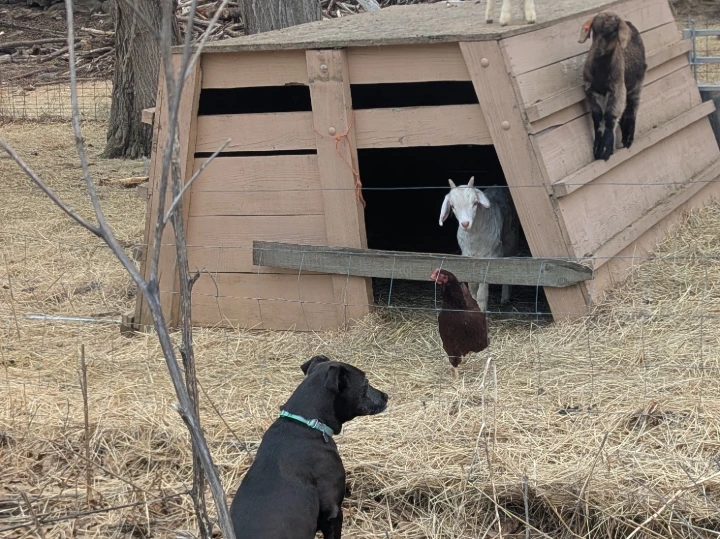
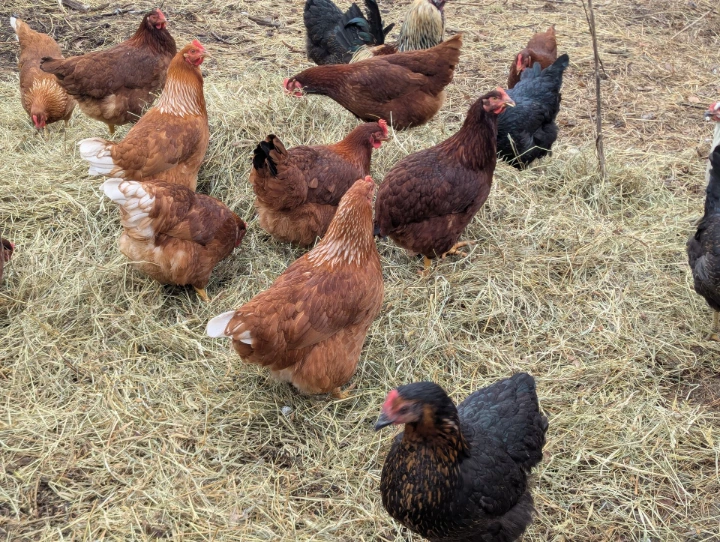
We don’t have any New Country Organics updates this month (although we’re terrified of what rising diesel costs will do to shipping in the near future), so we wanted to talk about a chicken management technique that we use several times a year: exploiting the chicken’s natural zombie-ness when it’s dark out. Zombies, you say? We’ll get there.
Because chickens are prey animals, we handle ours as little as possible. During the day, they are difficult to catch and any attempt to handle them is stressful (for them and us). When we do have to handle them, we do so under the cover of darkness. Dun, dun, dun…
A little-known fact about chickens is that their vision is quite poor and at night they need to protect themselves as well as they can without seeing much. Chickens roost (farmer jargon for sleep) up high, ideally with something over their heads and little below them, to help avoid predators while they’re vulnerable. Since they don’t really have any defense mechanisms at night, they conserve their energy by sleeping deeply and ignoring things that would be upsetting during the day.
Zombies! Handling chickens at night is similar (we imagine, having no real experience) to handling small, sleepy zombies (who cannot turn you into a zombie, even if they bite). Every year we need to combine or separate flocks of different ages, so we creep into their roost in the depth of night, with just a dim headlamp to light our way (we don’t see well in the dark either, but hey, better than chickens). We can peacefully pick up each chicken, count them, leg band them for identification, and sort them as needed.
This month we combined two of our chicken flocks under the cover of darkness and no farmers were turned into zombies, so it was a great success.
Find Us
On farm store: Every Wednesday noon - 2pm, every Saturday 1 - 3pm. Pre-order
On farm self pickup: Every day 8am - 8pm. Pre-order only
Wooster Square Market, New Haven CT: This market runs every Saturday from 9am - 1pm until the end of November. We will be there every other week. Dates we’ll be there in April: April 11 and April 25. Pre-order
Ask a Farmer Anything, Virtual Question Sessions: second Monday of every month from 7:30 to 8:30pm and fourth Thursday of every month from 8 - 9am. Dates in April: April 13 and April 23. Registration free but required
It's too many dates! Save me!
Want to get these blogs in your inbox? Sign up for our newsletter.