
Sheep potatoes?
Here at BOTL Farm, we don’t mind a good thought experiment now and again. So, let’s all imagine that we’re potato farmers, perhaps in Ireland in 1845. It’s been a lean winter, you’re hungry, but the weather is starting to break and you peer into the root cellar to start planting the seed potatoes. You’re terrified to see that all the seed potatoes have been turned into frozen french fries. What do you do now? Without seed potatoes, you’ll starve because you can’t plant next year’s crop.
In definitely-related news (wait wait, we’ll get there), we never intended to raise sheep. We wrote a 35-page business plan back when we were in the beginning stages of putting together our thoughts and money to buy a farm, and it had zero mentions of sheep. The universe thought it knew better and shortly after we’d established our farm, we got a call from our previous farming mentor to let us know that she was getting out of farming and she was going to deliver us three of her ewes (farmer jargon for breeding-female-sheep) and their six collective lambs. We’ve been raising sheep since then.
So, let us now imagine on the potato farm in Ireland, the seed potatoes are actually sheep and you’re in Ashford, CT in 2024. Last fall, we made the difficult decision to turn our sheep into fries. This analogy is rapidly breaking down, but just imagine we’re still coherent. The moral of the story is that we no longer raise sheep and what remains of our flock can only be found in freezers.
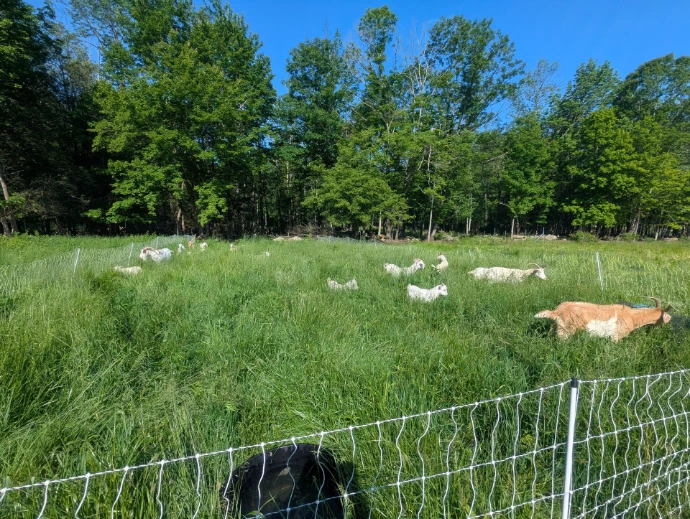
Why did we stop raising sheep? Small ruminants (farmer-jargon for a class of animals that includes goats and sheep) are a good fit for our farm. But, we found goats to be a better fit for our personalities and farming expectations. We could write a small book about why, but rest assured there were decision trees, multimodal model runs, and discussions that stretched over years.
For now, we still have some mutton (farmer jargon for sheep older than two years) in the freezer, as well as lamb bone broth, hides, and assorted pet treats. But, what we have now is the last that we’ll have. We are expanding our goat herd to make up the difference, so maybe consider trying some goat meat if you’ve never had any before.
Another hay season is complete
Since we feed hay (dried grasses) to our animals during the winter, we have to gather hay during the summer when grass grows best and then store it until winter. We don’t have enough open fields to simultaneously feed our animals grass during the summer and grow grass to harvest as hay for the winter. Instead, we work closely with another local farm who rents hay fields, tends, cuts, threshes, bales, and all the other farmer jargon for hay, so that we can show up and pick up the finished bales of hay off the fields. This is mutually beneficial: the hay farmers don’t have to pick up, stack, move, and store the hay bales: we don’t have to buy and maintain hay equipment, we just use our trailer to pick up the bales from the fields and stack them in our storage barn.
The sticky part of haying is this: we don’t get to choose when the grass is ready to be cut or when there’s a “hay window” of several days without rain, where the grasses can be cut, dried in the sun, turned using a hay-turn-y thing (probably has a real name, we don’t know), and bailed without being rained on. Unfortunately for us, we get notice that the hay farmers are cutting and expect us to pick up hay bales in three days. Hot and dry weather is best for hay.
Last week we spent 7 hours on the hottest day of the year picking up and stacking hay bales. Luckily the yield was large, so as of this week we have enough hay to get us through winter.
Where's the bacon?
At the end of each summer market season, we sit down together for a debriefing session where we reflect on the market season. We identify what sold well that year (2024 was terrible for spareribs), the quirks of each market (Sturbridge is the best place to move dog treats), and how to optimize our market tent setup (we’re continually tweaking the sign board that shows what cuts we have at market). Based on this experiential data, we make changes and set new priorities for the next year or two.
Turns out, this may not be the best plan (and you know we love a good plan). We’re making decisions about what cuts to produce for the season well in advance of when we know what the latest TikTok viral recipe will be (is TikTok one word? I’m old).
We often function like a poor forecasting algorithm: country-style ribs sold like hotcakes (for the record, we don’t actually know what hotcakes are but we think it’s a thing) last year, so we obviously cut more country-style ribs for this year, and now they’re not moving. It’s like ‘targeted’ advertisements on your phone that notice you bought a dishwasher and try really hard to sell you, that’s right, another dishwasher.
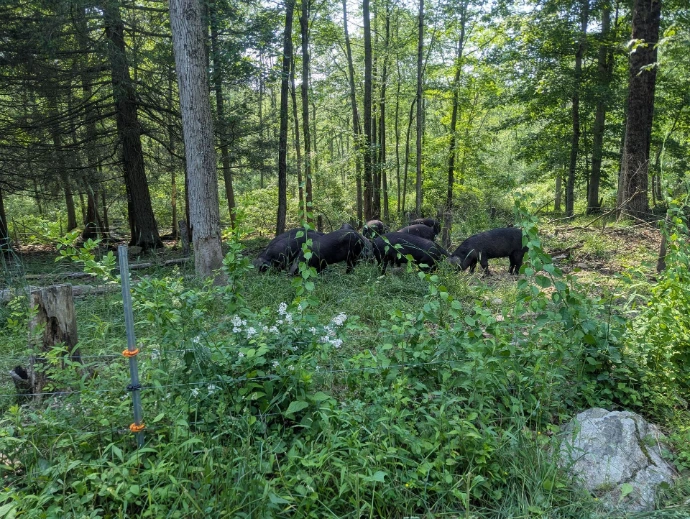
For years, jowl bacon was not a great seller. It’s a beautiful, wonderful cut that’s salty and fatty so we always made some for ourselves but turned the rest into bacon ends, which sold more reliably. This year, the trend has reversed and we’re completely sold out of jowl bacon but have mountains of bacon ends.
All this to say, we’re sold out of some favorites, we’re low on some others, and we’re overstocked on some other cuts. Cheers.
Organic animal feed: updates to the farm store
Often, people make changes to their spaces for aesthetic reasons, like updating the color palette or modernizing the furniture. Farmers often make changes for utilitarian reasons. We recently changed the farm-milled wood-table setup at our farm store to metal-rack shelving. Why? Mice. Or maybe chipmunks.
We tolerate a polite amount of rodents in our farming and 200+ year old house lifestyle, but the amount of damage we were experiencing to the ultra premium organic animal feed we resell was a little much. The change in shelving makes the store feel a bit smaller, but hopefully it results in better outcomes for our feed and feed customers. Initial results are very promising!
Find us this month
On farm store: Tuesdays noon - 2pm, Saturdays 1 - 3pm. Pre-order
On farm self pickup: Everyday 8am - 8pm. Pre-order only
Wooster Square, New Haven CT: This market runs every Saturday from 9am - 1pm until the end of November. We will be there every other week. Dates we’ll be there in July: July 05, July 19. Pre-order
Assawaga Farm Market, Putnam CT: This market runs every. Saturday 9am - noon until the Saturday before Thanksgiving. We will be there every other week. Dates we’ll be there in July: July 12, July 26. Pre-order
Sturbridge Farmers Market, Sturbridge MA: This market runs every Sunday 9am - 1pm until October. We will be there every week. Dates we’ll be there in July: July 06, July 13, July 20, July 27. Pre-order
It's too many numbers! Save me!
Want to get these blogs in your inbox? Sign up for our newsletter.